Work Bench Notes-The Mighty Skew

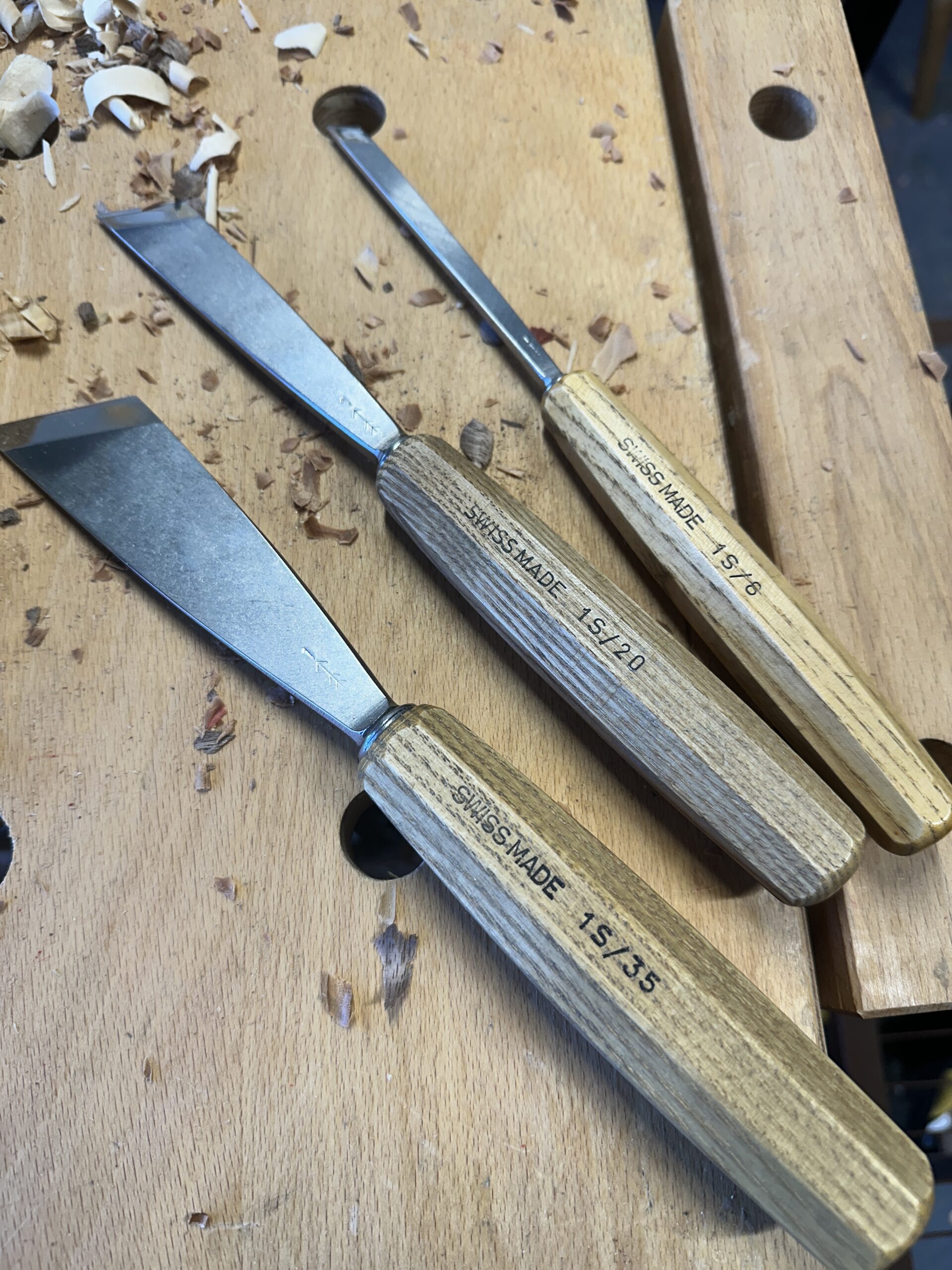
When I was at the Geisler Morodor Woodcarving school in Austria there was 40mm Skew in the student tool kit. I had never really used this tool before and after a week of carving with it I ordered a 20mm and 35mm skew for my personal tools. I am partial to the Swiss Pfiel tools mainly due the flats on the handle which stop it from rolling and the fact the steel is of such high quality. I wanted to visit the factory but they had limited tour windows that did not align with my time in the region. Maybe next time.

I am not a tool collector, but in this case it was incredibly useful despite the fact I laid my hand open on it in the first 90 minutes of class, but that is another story.

The skew is an incredibly versatile tool mainly due to the fact that it can execute a slicing cut much easier than a standard flat gouge. You can also align the tip into some pretty small spaces. It is also incredibly easy to sharpen. Literally lay it down with the bevel on the stone, move forward holding the bevel in place 5-8 times and repeat on the other side. Then hone the same way.

Nutcracker Carvings


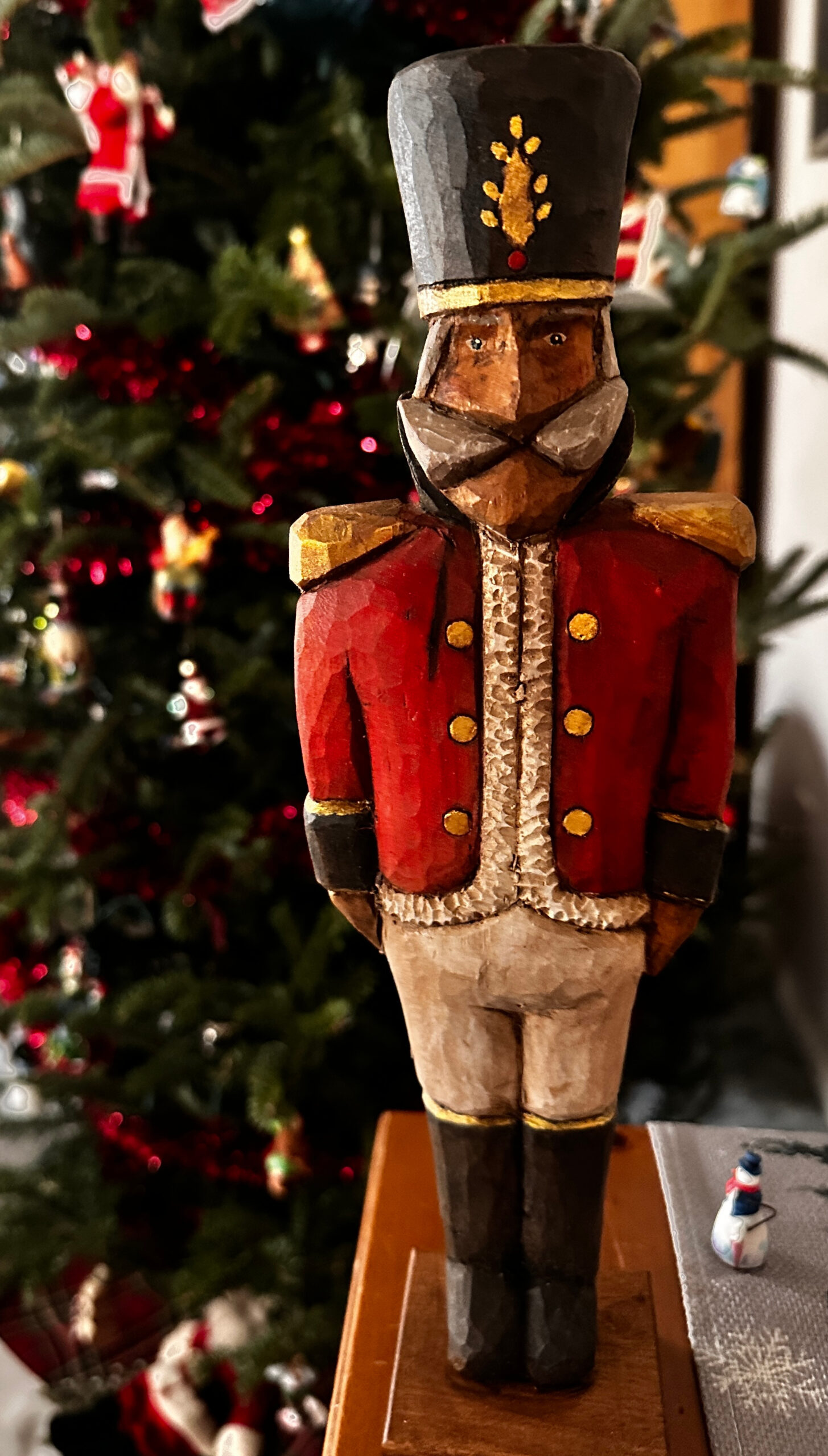
Nutcrackers are a fascinating carving project with literally endless variations in styles and colors. This project began with research into the history of these figure based nutcrackers. I was inspired to do this since my young Grandchildren had an interest int these figures after seeing them at a Christkindlmarkt.

After researching the styles and histories I began making sketches, settling in on a Prussian officers tunic as the style, I decided to make the Mustache the key feature while the rest is fairly angular. The images below show the overall process to make these carvings. I made three as gifts this year.

On these carvings I used a staining technique to get a vintage feel. After staining the colors i use a clear matte poly spray finish to fully seal the wood. I coat it with gel stain. I like General’s colonial maple. Use a toothbrush to get in all the crevices. Then with a clean rag scrub the gel stain off. There is an art to getting just the right amount off. In the images below the Nutcracker on the left with bright white pants has not been stained while the one on the right has, The first image shows the Nutcracker with the gel stain prior to it being wiped off.

These date back to 17th Century Germany when out of work miners used their carpentry skills to make the first versions of what we now know as nutcrackers

They were typically based on authority figures such as Prussian Soldiers and Kings. Common people were using these nutcrackers as a symbolic protest. They were having representations of authority work for them cracking nuts. In addition to the silent protest Nutcrackers were considered to be good luck totems. German homes typcially only had one nutcracker.

In 1892 Tchaikovsky’s suite tied these figures to Christmas and the Nutcrackers style that is still made today. .

Various factories specialized in mass producing Nutcrackers using lathes. After WW2 many American soldiers brought Nutcrackers back home to America.

See

Carved Pumpkin Patch Carvings

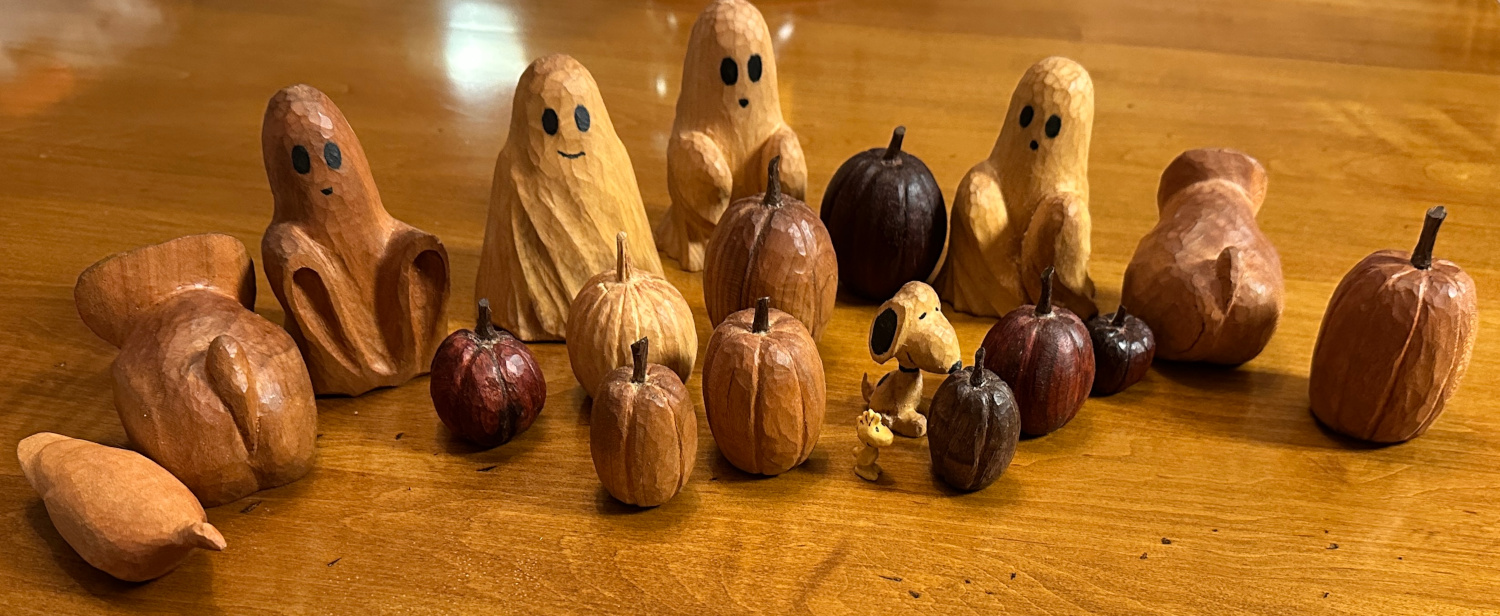
This year I carved a little pumpkin patch for someone with an October birthday. The Snoopy and Woodstock were later additions since she liked Charlie Brown. All pieces are out of hardwoods including Cherry, Walnut, Paduk, Mahogany and Redheart. They are all finished with my homemade beeswax then handrubbed to get a subtle matte finish. The turkeys were a later addition so it could be used for Thanksgiving as well.

Surprisingly the pumpkins are really difficult to carve. Any flat spots or errors in shape stand out much more than in other shapes. I don’t know the science behind it, but the human visual system is highly attuned to seeing errors in spherical shapes.

Work Bench Notes-Basic Sharpening Knives

Sharpening is the most important aspect of woodcarving. Clean cuts provide a crisp finished carving. Dull tools leave a torn cut. In addition, sharp tools are safer since they glide through the wood.

There are hundred’s of sharpening methods, jigs and other devices to get the perfect edge. All will work. The key is to develop a system you will use and stick with it until your tools are consistently sharp. My method is purely by eye and experience. My goal is only sharp tools, nothing else. It does not matter if the blade angle is 20 degrees or 21.5 degrees. It only matters that it is a quick process to get super sharp.

This post focus’ on sharpening straight edge tools such as knives, chisels and skews.

I use Norton (not sponsored) waterstones. They sharpen quickly. The only downside is they tend to dish quickly so they will need to be flattened as needed. Notice the thin ray of light passing under the square.

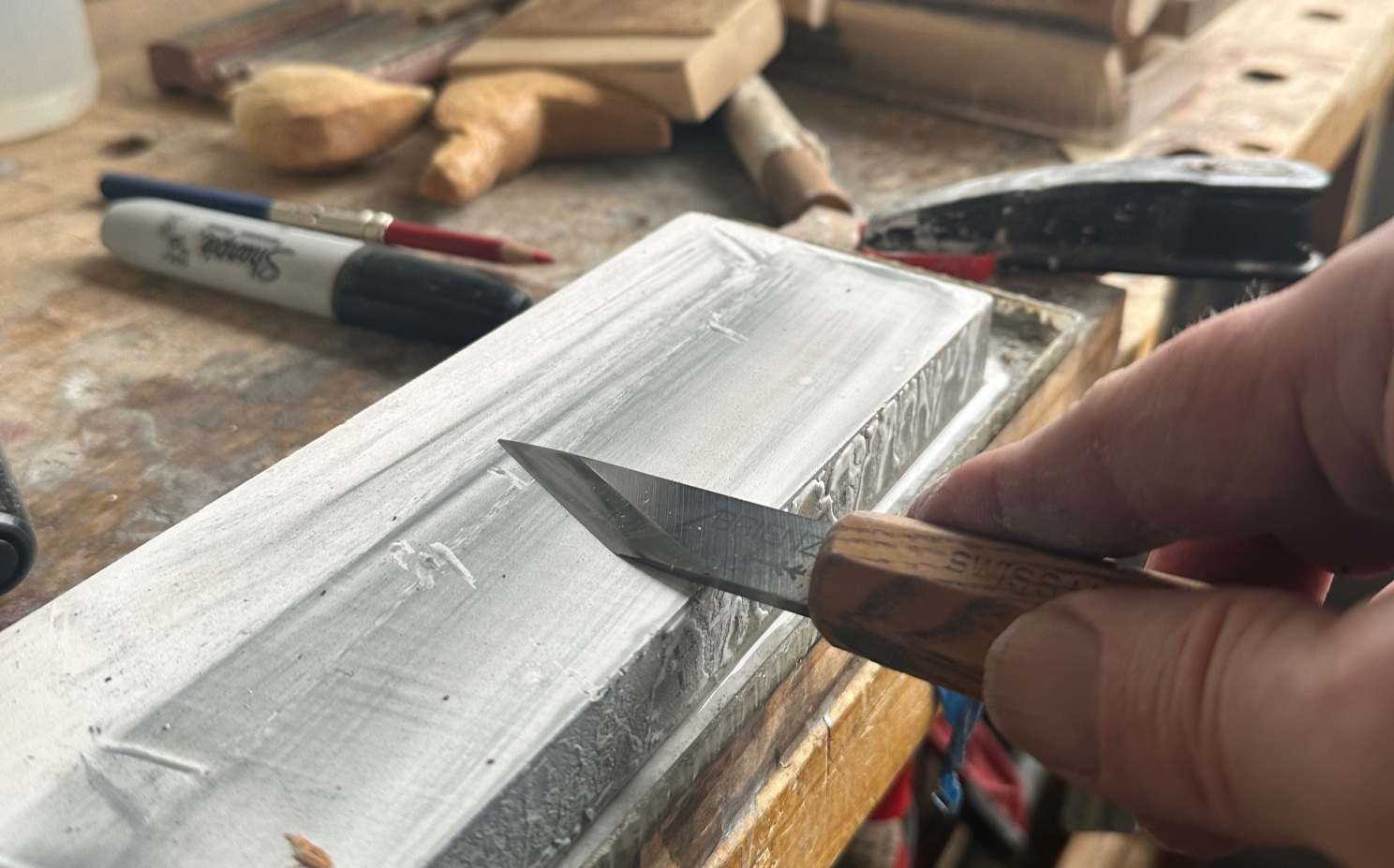
For knives and straight bladed tools like this skew look closely at the bevel. Align the bevel on the stone so it is lying flat on the stone and draw it away keeping pressure on the bevel without lifting or lowering. This sounds much easier than it is, but with practice anyone can do this. Repeat about 10 times, then do the same on the other side.

The video below shows the basic process. When laying the bevel down you can feel when the full bevel is making contact. You can also see it as the water pushes up from the front of the stone. As i said it takes practice. When starting you can use a black sharpie to ink up the bevel, take one stroke and then you can see how close you are to the bevel and adjust the angle.

Next hone the blade on a honing strop with honing paste applied. You can make the honing strop on a flat piece of hardwood with a substrate to hold the honing paste glued to it. Maintaining the same angle strop 10 times one one side then repeat.

Test the sharpness with a block of wood. The idea of testing by shaving the hair on your arm or cutting paper is not worthwhile since all that matter is how the wood cuts. After time you can tell the sharpness by the sound as it cuts through the woodfibers, you can hear it in the video below.

Repeat honing often while carving. I often hone every 20 minutes or so. Once that is not getting you sharp enough go back to the stones.

dfsa

Small Animal Carvings

Work Bench Notes-Small Animal Carvings

Small Animal Carvings

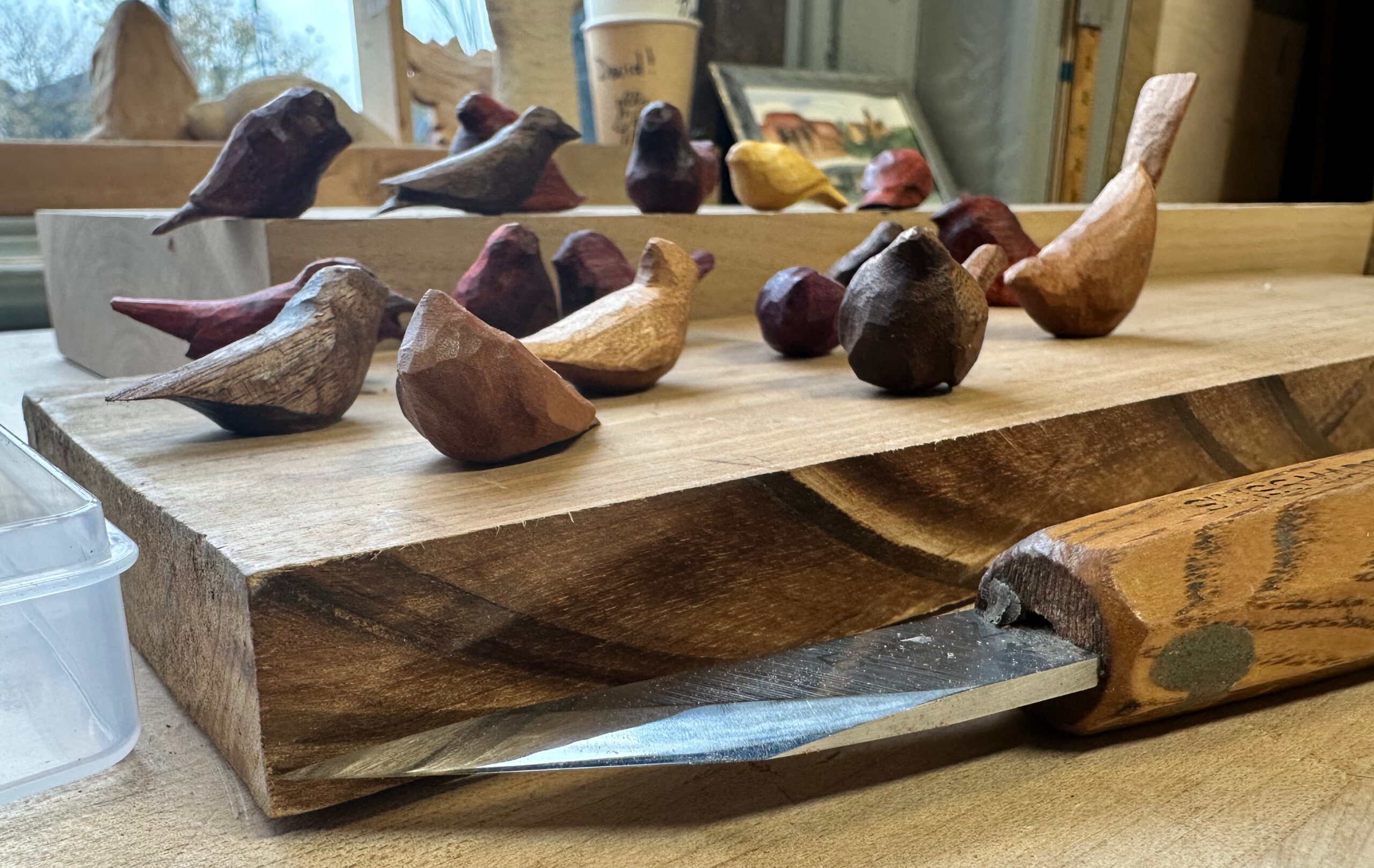
I started carving these little animals to relax while sitting down and then found i really enjoyed making them. I typically give them away.

If you wish to make them i recommend starting a little larger with Basswood. Make sure to wear a carving glove to avoid adding DNA to your carving.

To make these start with start with a small block of wood with an interesting figure. I typically use walnut, cherry, redheart or purpleheart cut from 3/4′ pieces. Draw the design on the wood and cut to rough shape with a bandsaw or coping saw. This example is a penguin in Cherry Wood.

Next you begin carving with a knife or take some bigger cuts in the vise with larger tools. Notice how the base is left on the carving which gives you the ability to hold in it in a vise. I use the Benchcrafted Hi-vise (again not sponsored) to raise the work up and hold it securely. You could use any vise or clamp if you dont have a vise like this or even hold it in your hands.
I use the Pfiel Brienz Carving Knife (not sponsored) for carving these figure. The reason why is that you can do a slicing cut with it along the skewed blade shape. This cut is really important in carving. It will take practice, Use as much of the blade as possible and slide along the bevel to make the cut. Be wary of the grain and switch if your digging in too deep.. In addition this cut allows to work in harder woods.

Once the initial shaping is done add in details like wings and beaks using the Brienz knife, files or other small tools. At this scale I recommend small cuts to suggest detail. I don’t put eyes or other fine details in my carvings.

Finally separate the carving from the base. I use a home made beeswax to finish these carvings. Put on one coat then buff it so the carnuba can shine.

I don’t have an exact recipe but the following will get you there with some practice. heat Raw Linseed oil in mason jar in a double boiler. Add in beeswax and about 10% carnuba. Dip a spoon in the mix and once it cools if it looks like candle wax it is good to go. Once the mixture cools it should be the consistency of peanut butter. You can always reheat and add more beeswax or Raw linseed oil if needed.

Once you get started it is hard to stop and the design ideas are endless. I really like to make whales as well as the birds. I started setting these up on door frames and pictures at the day job for people to find.

Bellamy Eagles

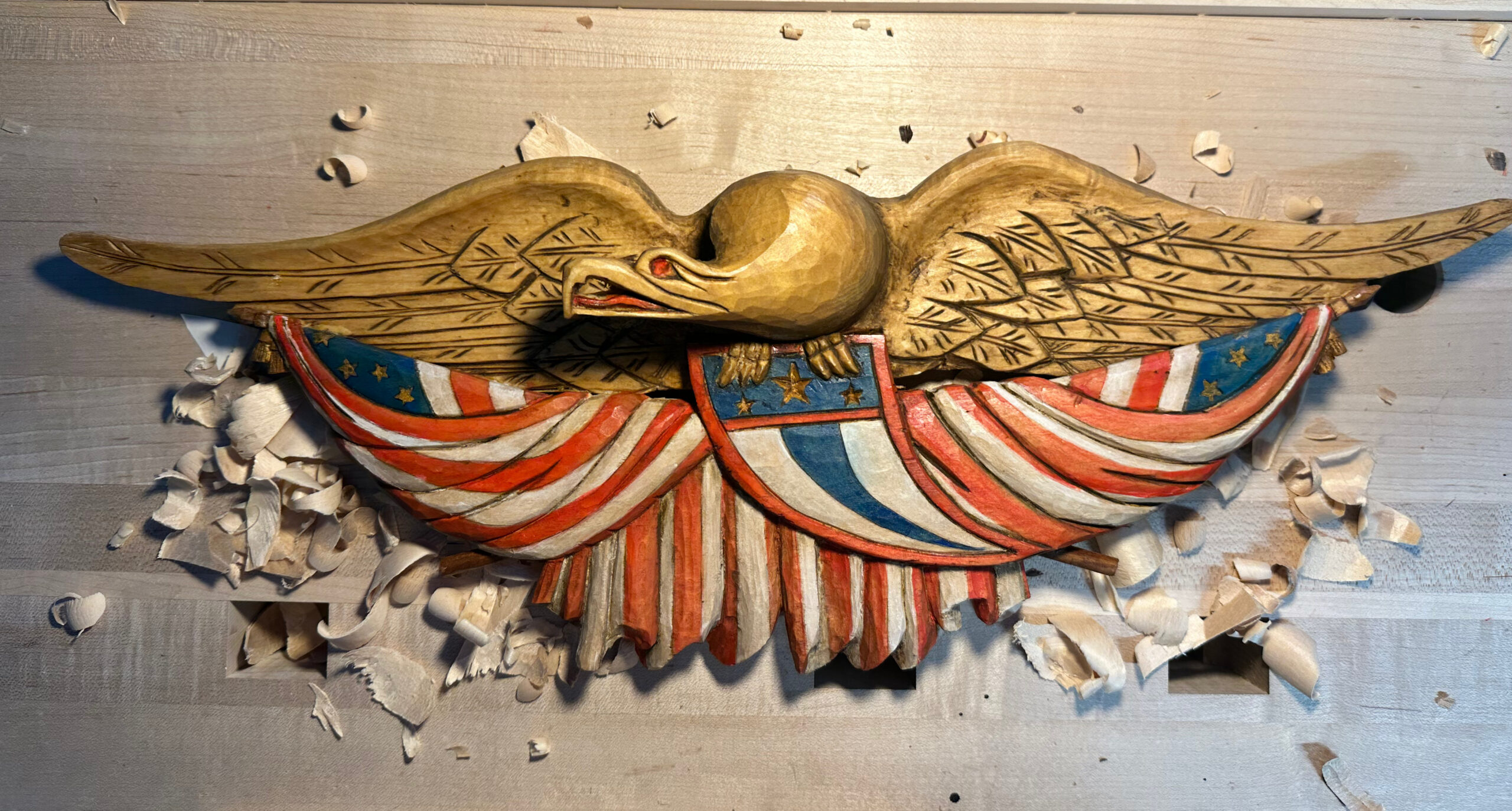
In the late 1800’s New England carver John Bellamy made a unique folk styled eagle. He often traded them for a bottle of whiskey. Today his work is in high demand and has gone for over $600,000 dollars in auction. I am in inspired by this style and have made many of these. Often they are retirement gifts for co-workers.

I typically make these with a base block for the body and wings then attach a larger piece for the head. This works better to attach the head after carving the feathers beneath. I often temporarily attach the head with woodscrews so i can remove it before attaching it permanently.

Another useful technique is to undercut from behind to give the illusion of much thinner wings but it retains it strength since the undercut is just in the first half inch or so.

St Nicholas Carvings

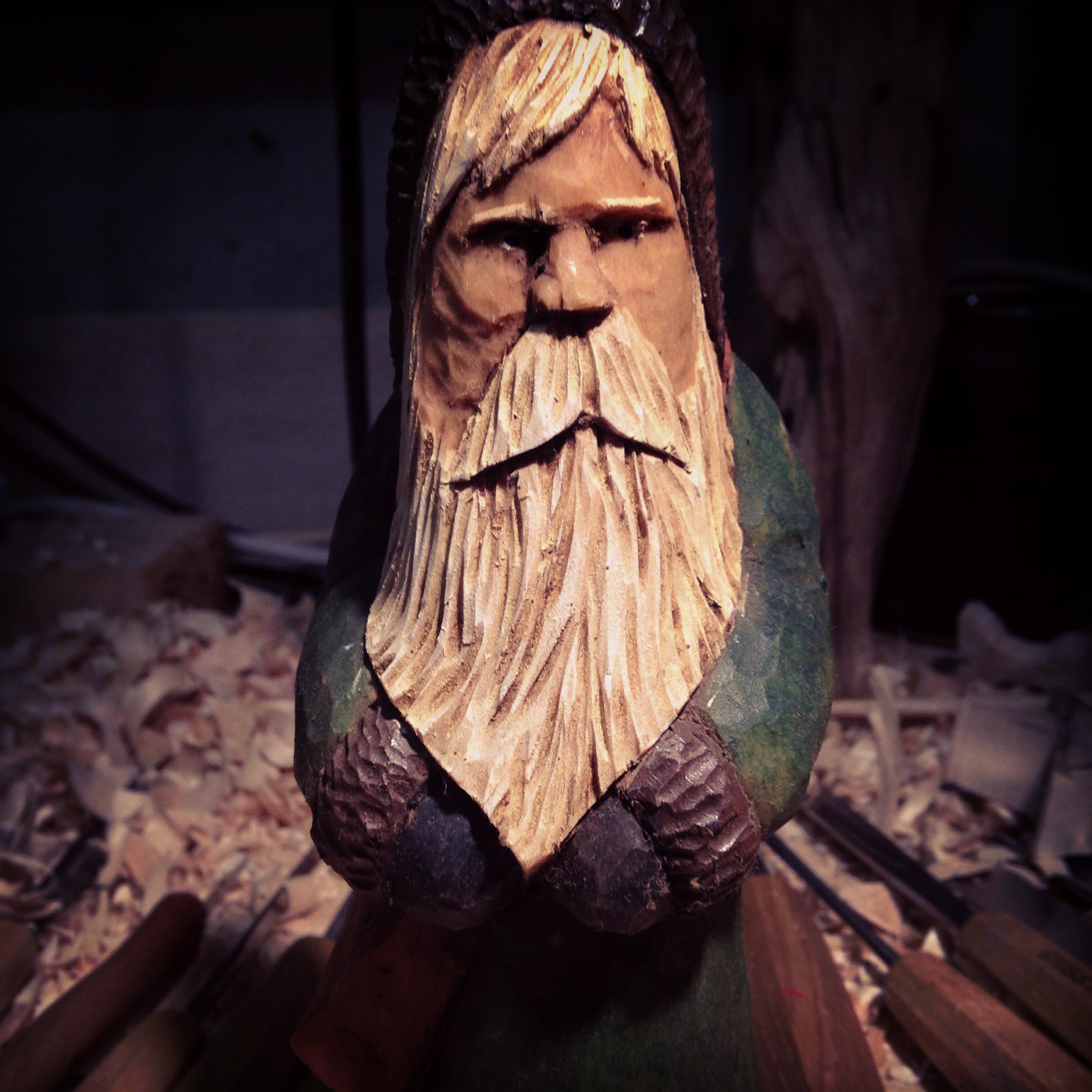
The following are examples of the hundreds of these carvings representing the gift givers of Christmas. Each one has a deep history to the region and is based on these legends. St Nicholas is most commonly known, but Julesnisse is from the Norway region. Belsnickles are German based. Interestingly many of these legends have a sidekick or helper as well such as the terrifying German Krampus.

Warped Wing Barrel Aged Whale

Great projects begin with great designs and this was an incredible design from noted illustrator John Pattison. This is our second collaboration for Warped Wing Brewery. We also did the Baltic Argonaut project in 2015. John did the design work for this mythical beast and helped at many critical design decisions on this massive 5′ long project.

The whale initially weighed over 75 pounds and was made from a single 12′ long piece of basswood that was cut up and glued up in the rough shape of the design.

The cardboard mockup was essential to getting the shapes right.

The project was so big I worked on it hanging on the wall to visualize how it would look when finished.

A tale of two Snowmen

Several years ago I made the snowman below as a gift. One year it got misplaced and was assumed lost. Another year went by and I realized it would never be found. Another year or two went by when I got around to remaking it.

I did not remember that there was a photo of Mr. Snowman and made it from memory. As expected within months of finishing the new Snowman the original was found, albeit with broken arms. The fact that they are so similar shows that I have reached the point of working consistently.