Work Bench Notes-Basic Sharpening Knives
Sharpening is the most important aspect of woodcarving. Clean cuts provide a crisp finished carving. Dull tools leave a torn cut. In addition, sharp tools are safer since they glide through the wood.
There are hundred’s of sharpening methods, jigs and other devices to get the perfect edge. All will work. The key is to develop a system you will use and stick with it until your tools are consistently sharp. My method is purely by eye and experience. My goal is only sharp tools, nothing else. It does not matter if the blade angle is 20 degrees or 21.5 degrees. It only matters that it is a quick process to get super sharp.
This post focus’ on sharpening straight edge tools such as knives, chisels and skews.
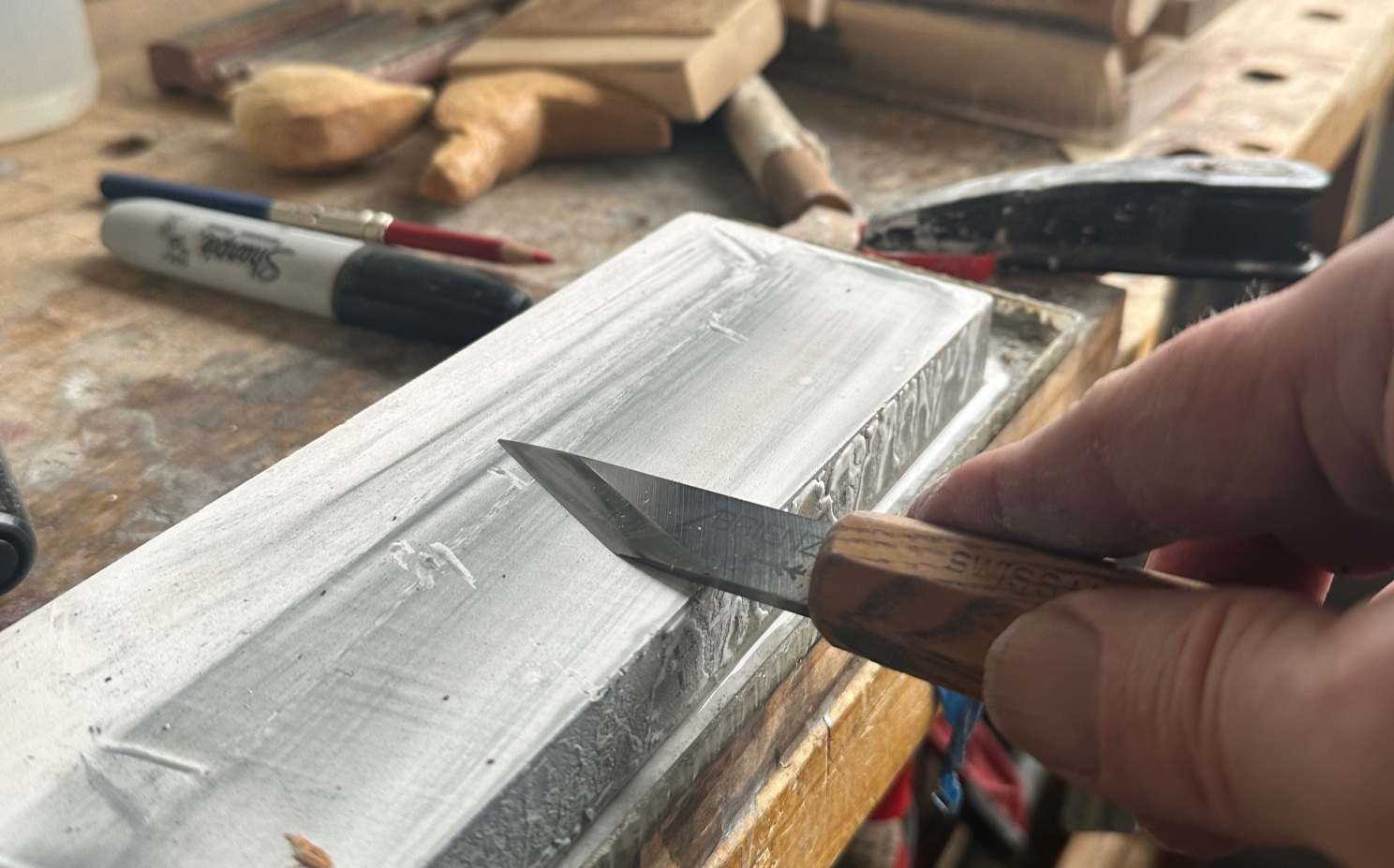
I use Norton (not sponsored) waterstones. They sharpen quickly. The only downside is they tend to dish quickly so they will need to be flattened as needed. Notice the thin ray of light passing under the square.

For knives and straight bladed tools like this skew look closely at the bevel. Align the bevel on the stone so it is lying flat on the stone and draw it away keeping pressure on the bevel without lifting or lowering. This sounds much easier than it is, but with practice anyone can do this. Repeat about 10 times, then do the same on the other side.

The video below shows the basic process. When laying the bevel down you can feel when the full bevel is making contact. You can also see it as the water pushes up from the front of the stone. As i said it takes practice. When starting you can use a black sharpie to ink up the bevel, take one stroke and then you can see how close you are to the bevel and adjust the angle.
Next hone the blade on a honing strop with honing paste applied. You can make the honing strop on a flat piece of hardwood with a substrate to hold the honing paste glued to it. Maintaining the same angle strop 10 times one one side then repeat.
Test the sharpness with a block of wood. The idea of testing by shaving the hair on your arm or cutting paper is not worthwhile since all that matter is how the wood cuts. After time you can tell the sharpness by the sound as it cuts through the woodfibers, you can hear it in the video below.
Repeat honing often while carving. I often hone every 20 minutes or so. Once that is not getting you sharp enough go back to the stones.
dfsa